I have a great deal of experience with secrets. Back before I was on the run, I kept the secrets of people with too much money and power and not enough humility. I kept the secrets of a CEO who didn't know how to lock down his email properly. I kept the secrets of a CFO who wet his whiskers in company cream (yes, Wallace. You).
Now, I keep only my own secrets. This is the best part of my new life, reader: All of my secrets are mine. The burden of my own secrets is somewhat heavy - but oh, so much lighter than the secrets of others. I hope never to pick up anyone else's secrets ever again.
Disclaimer is about the burden of secrets and the weight of memory. Does one have the right to carry the secrets of another in order to protect their memory? And, who decides which memories are worth protecting?
Disclaimer by the respectable Renee Knight...
...is tolerable, especially for patient readers.
This book is of course compared to Gone Girl, which does a disservice to both books. I shall disillusion you right away, reader: this book is not Gone Girl. I think that the comparison arises from the fact that the characters are not particularly sympathetic; that is the only similarity I could find.
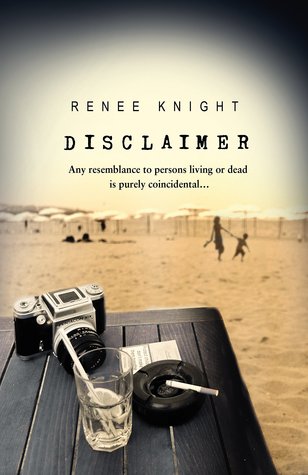
When allowed to stand on its own, the premise of Disclaimer is strong: a woman finds a book on her nightstand, and it turns out to be about her. The story within that book details events that unfolded several years earlier, when the woman was in Spain with her then-young son.
Disclaimer moves at the approximate pace of a heavily sedated chameleon, but maintains just enough suspense to draw the reader through the plot. The promise of a reveal is strong: we are going to find out what happened in Spain. We participate in this story through multiple character perspectives, and witness the decay of relationships and the power of grief from every conceivable angle. The relationships between characters are deeply nuanced, and each individual is given believable - even trustworthy - motivations and reactions.
The problem with Disclaimer is that it is so very glacial. I love drawn-out tension as much as the next fugitive book reviewer, but Disclaimer leans too hard into drawn-out and doesn't touch tension. The mystery of "how did the book get on the nightstand?" extends through a significant portion of the first act - which is why it's the only mystery addressed in the blurbs scattered across the internet - but it's discarded and exchanged for other, deeper mysteries later on. The fact that the extremely dissatisfying solution to that particular mystery takes so long to resolve is why I am putting all discussion of the real mystery of the book in the spoilers - because if you are planning to read this book, you will want something to hope for throughout the first half of it.
Now, for Spoilers.
This book is of course compared to Gone Girl, which does a disservice to both books. I shall disillusion you right away, reader: this book is not Gone Girl. I think that the comparison arises from the fact that the characters are not particularly sympathetic; that is the only similarity I could find.
When allowed to stand on its own, the premise of Disclaimer is strong: a woman finds a book on her nightstand, and it turns out to be about her. The story within that book details events that unfolded several years earlier, when the woman was in Spain with her then-young son.
Disclaimer moves at the approximate pace of a heavily sedated chameleon, but maintains just enough suspense to draw the reader through the plot. The promise of a reveal is strong: we are going to find out what happened in Spain. We participate in this story through multiple character perspectives, and witness the decay of relationships and the power of grief from every conceivable angle. The relationships between characters are deeply nuanced, and each individual is given believable - even trustworthy - motivations and reactions.
The problem with Disclaimer is that it is so very glacial. I love drawn-out tension as much as the next fugitive book reviewer, but Disclaimer leans too hard into drawn-out and doesn't touch tension. The mystery of "how did the book get on the nightstand?" extends through a significant portion of the first act - which is why it's the only mystery addressed in the blurbs scattered across the internet - but it's discarded and exchanged for other, deeper mysteries later on. The fact that the extremely dissatisfying solution to that particular mystery takes so long to resolve is why I am putting all discussion of the real mystery of the book in the spoilers - because if you are planning to read this book, you will want something to hope for throughout the first half of it.
Now, for Spoilers.
The book takes ages to get to the actual meat of the plot, but here it is: There are photos of our main character which depict her engaging in sex acts with someone other than her husband, while on vacation with their very young son some fifteen years before. The young man who took the photos died the day after they were taken. The main character keeps insisting that the photos aren't what they look like, and in a bizarre comedy of sitcom-esque miscommunications, her life begins to crumble.
The miscommunications are the most frustrating part of this book by a long shot. Our main character keeps telling people that she needs to explain what really happened, but when given the chance, she unnecessarily stalls. This is emblematic of the book itself: it unnecessarily stalls. I guessed the surprise twist ending early on (something that I usually don't do, but it happens from time to time no matter how hard I try to resist), and watching the mishaps that led to other characters not even beginning to guess was painful.
So. Here's the reveal, reader: she was raped. Nobody stopped to even think that this might be the case, but there you have it. She kept it a secret for years, for the same reason many women do - shame, and horror, and the need to carry on. And when she is discovered by the father of the young man who took the photos - when he goes about trying to ruin her marriage and her career, when he threatens her life - she continues to keep it a secret.
I have two issues here. The first is the notion that a rape ruins a woman's life - that even if it doesn't ruin her life right away, it will catch up with her sooner or later, and ruin her. It even ruins her son's life - the final twist in the book, and the only one that took me by surprise, is that the five-year-old boy witnessed the rape, and it left him indelibly emotionally scarred. The moral of the story: You can't move past trauma without being thoroughly punished for having endured it.
The second issue I take with this theme is the weight of shame. Many women who are raped come away from the ordeal with a burden of shame. This book depicts that with realism at first, but later in the story, the shame becomes fetishistic. The woman is so obsessed with her shame that she allows her career and marriage to dissolve rather than speak up about the reality of what happened to her.
And when she does finally defend herself, the result is precisely what one would expect: people are horrified at what happened to her. People are horrified on her behalf. The father of the young man - the father who has been attempting to punish her (for what, by the way? For having sex with his son? This is never really clear) - is horrified, immediately attempts to rectify the situation, and then kills himself.
I can understand our main character deciding to keep her rape a secret, reader. Secrets weigh us down, but sometimes that weight is the only possible option. And yet, later on, her refusal to release that burden becomes entirely unrealistic. If she had simply told her husband and the father of the boy about the rape as soon as the blackmail began, the book would have no plot. I found myself again and again comparing the plot of Disclaimer to an episode bad sitcom: Oh, Gosh, It Was Just All One Big Misunderstanding!
This book did not make me angry or upset, but when I put it down, I felt that my time had been wasted. Save yourself that same fate, reader. Watch an episode of Full House (I hear it's on Netflix now) and read a Clive Barker short story to get your dose of darkness in. I promise, doing those two things will provide you with the same overall experience, and then you can move on to something better.
The miscommunications are the most frustrating part of this book by a long shot. Our main character keeps telling people that she needs to explain what really happened, but when given the chance, she unnecessarily stalls. This is emblematic of the book itself: it unnecessarily stalls. I guessed the surprise twist ending early on (something that I usually don't do, but it happens from time to time no matter how hard I try to resist), and watching the mishaps that led to other characters not even beginning to guess was painful.
So. Here's the reveal, reader: she was raped. Nobody stopped to even think that this might be the case, but there you have it. She kept it a secret for years, for the same reason many women do - shame, and horror, and the need to carry on. And when she is discovered by the father of the young man who took the photos - when he goes about trying to ruin her marriage and her career, when he threatens her life - she continues to keep it a secret.
I have two issues here. The first is the notion that a rape ruins a woman's life - that even if it doesn't ruin her life right away, it will catch up with her sooner or later, and ruin her. It even ruins her son's life - the final twist in the book, and the only one that took me by surprise, is that the five-year-old boy witnessed the rape, and it left him indelibly emotionally scarred. The moral of the story: You can't move past trauma without being thoroughly punished for having endured it.
The second issue I take with this theme is the weight of shame. Many women who are raped come away from the ordeal with a burden of shame. This book depicts that with realism at first, but later in the story, the shame becomes fetishistic. The woman is so obsessed with her shame that she allows her career and marriage to dissolve rather than speak up about the reality of what happened to her.
And when she does finally defend herself, the result is precisely what one would expect: people are horrified at what happened to her. People are horrified on her behalf. The father of the young man - the father who has been attempting to punish her (for what, by the way? For having sex with his son? This is never really clear) - is horrified, immediately attempts to rectify the situation, and then kills himself.
I can understand our main character deciding to keep her rape a secret, reader. Secrets weigh us down, but sometimes that weight is the only possible option. And yet, later on, her refusal to release that burden becomes entirely unrealistic. If she had simply told her husband and the father of the boy about the rape as soon as the blackmail began, the book would have no plot. I found myself again and again comparing the plot of Disclaimer to an episode bad sitcom: Oh, Gosh, It Was Just All One Big Misunderstanding!
This book did not make me angry or upset, but when I put it down, I felt that my time had been wasted. Save yourself that same fate, reader. Watch an episode of Full House (I hear it's on Netflix now) and read a Clive Barker short story to get your dose of darkness in. I promise, doing those two things will provide you with the same overall experience, and then you can move on to something better.
Rating: Tiresome.
Possible ratings: Magnificent, Divine, Satisfactory, Tiresome, Lamentable, Execrable. This is a blog about words, what rating system did you expect?